Sacred geography
The Shakti Peethas
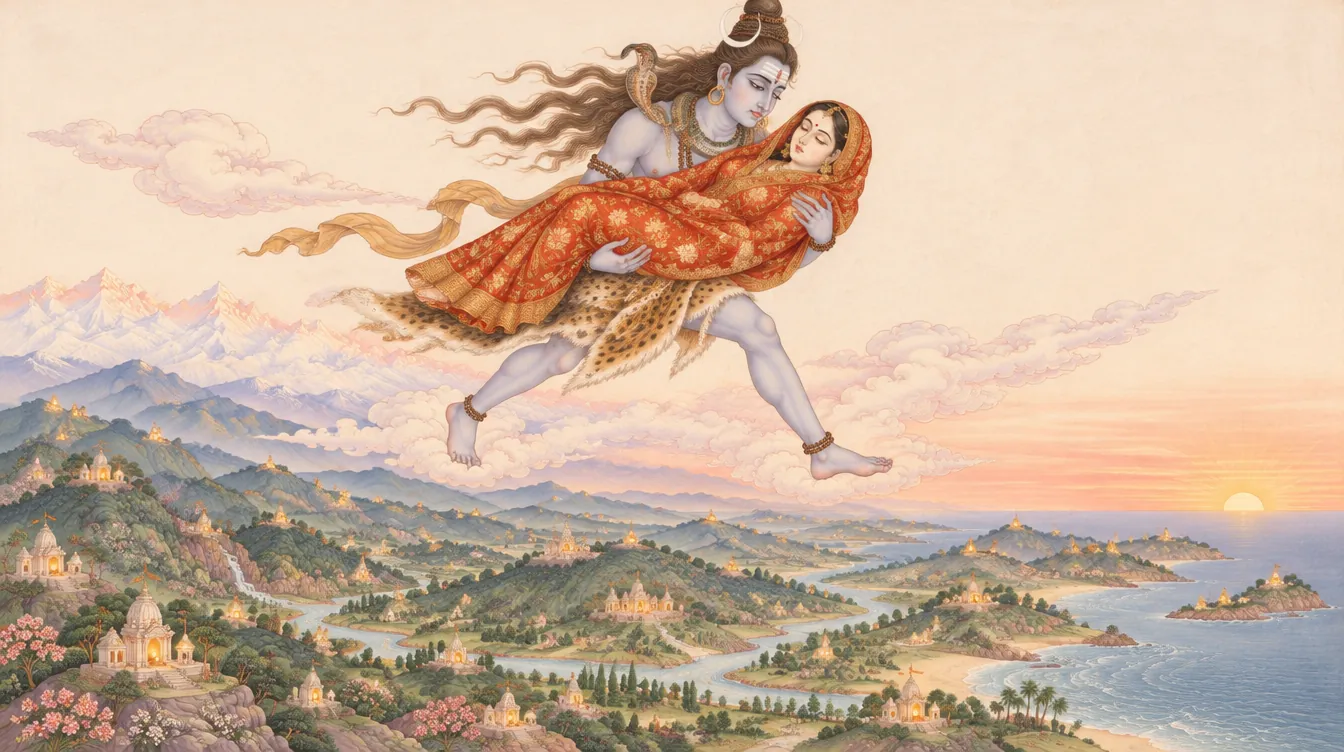
66 seats of the Goddess across India, Nepal, Bangladesh, Pakistan, Sri Lanka and Tibet, each linked to the story of Sati.
There is no single fixed list of Shakti Peethas. The story of Sati's body being divided and falling across the subcontinent is told in several Puranas and Tantras, and each counts and names the sites in its own way. The list most people mean by 'the 51 Shakti Peethas' comes from the Pithanirnaya, also called the Mahapithanirupana, a late medieval text transmitted in the Tantra Chudamani tradition of Bengal. For each seat it names a form of the Goddess, a guardian Bhairava, and the limb or ornament said to have fallen there. The historian D. C. Sircar (1948) compared its manuscripts and found that they disagree, that some names arose from copying errors, and that one manuscript reaches 52 through such confusion; this helps explain why some people, especially in Bengal, speak of 52 seats, and why popular 52 lists do not agree on what the 52nd is. The Shivacharita follows much of the same list (Sircar counts about 42 names in common), places ten seats at Kamarupa, and adds 26 lesser Upapithas. The Devi Bhagavata Purana and the Matsya Purana give separate lists of 108 sacred places of the Goddess, naming her form at each place rather than a fallen body part, and the number 108 is often used in that sense. The Kalika Purana speaks of four or seven principal pithas, and other Tantras give 42, 50 or 64. A further tradition, strong in South India, honours 18 Maha Shakti Peethas from a short hymn (the Ashtadasha Shakti Peetha Stotram) that is traditionally attributed to Adi Shankaracharya; that attribution is not established by scholars, and the hymn names places and Goddesses but not body parts. Many identifications are themselves contested, because the old texts give region names and later devotees, temple traditions and scholars have matched them to particular temples, sometimes in more than one place or country. This file follows Sircar's numbering of the Pithanirnaya for the 51, adds the 18 seats of the Ashtadasha hymn (six of which coincide with Pithanirnaya seats), and three widely honoured seats (Vimala at Puri, Tara Tarini, and Ambaji). Where a location is disputed the main alternatives are listed. Body parts, Devi names and Bhairava names are given as the tradition states them; they are matters of faith and devotion, and different communities honour them in different ways. Coordinates marked 'approx' are for the town or area rather than the shrine, and 'unknown' means no site can be named.
Some pins mark the town rather than the shrine. Map data © OpenStreetMap contributors.
Hingula (Hinglaj)
हिंगुला (हिंगलाज)
Goddess: Kottari (Kottavi); locally Hinglaj Mata, also called Bibi Nani · Bhairava: Bhimalochana
Said to be where her Brahmarandhra (crown of the head) fell.
D. C. Sircar, 'The Sakta Pithas', Journal of the Royal Asiatic Society of Bengal, Letters, vol. XIV (1948): tabulated list of the Pithanirnaya (Mahapithanirupana) and notes (archive.org scan) · Wikipedia: Hinglaj Mata Temple
Karavira (Sharkarara)
करवीर (शर्करार)
Goddess: Mahishamardini · Bhairava: Krodhisha
Said to be where her Three eyes (trinetra); popular lists say eyes fell.
The site is not agreed. Karavira is an old name of Kolhapur in Maharashtra, and Sircar notes that Karavira is also often equated with a place called Sharkarara in Sind. Popular modern lists name 'Sharkarare' near Karachi in Pakistan, and some name Naina Devi in Himachal Pradesh. No coordinates are given because no single site can be named.
D. C. Sircar, 'The Sakta Pithas', Journal of the Royal Asiatic Society of Bengal, Letters, vol. XIV (1948): tabulated list of the Pithanirnaya (Mahapithanirupana) and notes (archive.org scan) · Hindi Wikipedia: template table of the 51 Shakti Peethas (इक्यावन शक्तिपीठ)
Sugandha
सुगन्धा
Goddess: Sunanda · Bhairava: Tryambaka
Said to be where her Nose fell.
D. C. Sircar, 'The Sakta Pithas', Journal of the Royal Asiatic Society of Bengal, Letters, vol. XIV (1948): tabulated list of the Pithanirnaya (Mahapithanirupana) and notes (archive.org scan) · Wikipedia: Sugandha Shakta pitha
Kashmira (Amarnath)
काश्मीर (अमरनाथ)
Goddess: Mahamaya · Bhairava: Trisandhyeshvara
Said to be where her Throat (kantha) fell.
The text names only Kashmir. Popular tradition places the seat at the Amarnath cave; Sircar regards the description as partly fanciful and does not fix a site.
D. C. Sircar, 'The Sakta Pithas', Journal of the Royal Asiatic Society of Bengal, Letters, vol. XIV (1948): tabulated list of the Pithanirnaya (Mahapithanirupana) and notes (archive.org scan) · Wikipedia: Amarnath Temple
Jvalamukhi
ज्वालामुखी
Goddess: Siddhida (Ambika); Vaishnavi in the Ashtadasha hymn · Bhairava: Unmatta
Said to be where her Tongue fell.
Coordinates are for Jawalamukhi town, where the temple stands. The Ashtadasha hymn's 'Jvalayam Vaishnavi' is usually read as this temple, though some devotees connect the name Vaishnavi with Vaishno Devi in Jammu.
D. C. Sircar, 'The Sakta Pithas', Journal of the Royal Asiatic Society of Bengal, Letters, vol. XIV (1948): tabulated list of the Pithanirnaya (Mahapithanirupana) and notes (archive.org scan) · Wikipedia: Jawalamukhi
Jalandhara
जालन्धर
Goddess: Tripuramalini · Bhairava: Bhishana
Said to be where her Breast (left, in popular lists) fell.
Popular lists place this seat at Devi Talab Mandir in Jalandhar city. Sircar notes that the pitha itself was located near Jvalamukhi, and some traditions identify the Jalandhara seat with the Vajreshwari (Bajreshwari) temple at Kangra.
D. C. Sircar, 'The Sakta Pithas', Journal of the Royal Asiatic Society of Bengal, Letters, vol. XIV (1948): tabulated list of the Pithanirnaya (Mahapithanirupana) and notes (archive.org scan) · Wikipedia: Devi Talab Mandir
Vaidyanatha (Deoghar)
वैद्यनाथ
Goddess: Jayadurga · Bhairava: Vaidyanatha
Said to be where her Heart fell.
Sircar identifies this seat with Deoghar. Some popular lists instead give the heart to Ambaji in Gujarat (see the Ambaji entry).
D. C. Sircar, 'The Sakta Pithas', Journal of the Royal Asiatic Society of Bengal, Letters, vol. XIV (1948): tabulated list of the Pithanirnaya (Mahapithanirupana) and notes (archive.org scan) · Wikipedia: Baidyanath Temple
Nepala
नेपाल
Goddess: Mahamaya (Mahashira in some lists) · Bhairava: Kapali
Said to be where her Both knees fell.
Many lists identify this seat with Guhyeshwari temple near Pashupatinath (coordinates given are for Guhyeshwari). Nepalese tradition (Nepal Mahatmya, as summarised on Wikipedia) places the knees at the confluence of the Bishnumati and Bagmati rivers with Mahamaya as the Goddess, and treats Guhyeshwari as a separate seat where a different part fell.
D. C. Sircar, 'The Sakta Pithas', Journal of the Royal Asiatic Society of Bengal, Letters, vol. XIV (1948): tabulated list of the Pithanirnaya (Mahapithanirupana) and notes (archive.org scan) · Wikipedia: Guhyeshwari Temple
Manasa (Manasarovar)
मानस
Goddess: Dakshayani · Bhairava: Amara (Hara)
Said to be where her Right hand fell.
The seat is a stone by the lake rather than a built temple; coordinates are for the lake.
D. C. Sircar, 'The Sakta Pithas', Journal of the Royal Asiatic Society of Bengal, Letters, vol. XIV (1948): tabulated list of the Pithanirnaya (Mahapithanirupana) and notes (archive.org scan) · Wikipedia: Lake Manasarovar
Viraja (Biraja, Jajpur)
विरजा
Goddess: Vimala (Pithanirnaya); Girija in the Ashtadasha hymn; worshipped as Biraja · Bhairava: Jagannatha
Said to be where her Navel fell.
The Pithanirnaya names 'Viraja-kshetra in Utkala' with the Goddess Vimala and Bhairava Jagannatha. Sircar identifies Viraja-kshetra with Jajpur. Popular lists often place this seat instead at the Vimala temple inside the Jagannath temple at Puri. The Ashtadasha hymn's 'Odhyane Girija' is usually read as Biraja of Jajpur.
D. C. Sircar, 'The Sakta Pithas', Journal of the Royal Asiatic Society of Bengal, Letters, vol. XIV (1948): tabulated list of the Pithanirnaya (Mahapithanirupana) and notes (archive.org scan) · Wikipedia: Biraja Temple
Gandaki (Muktinath)
गण्डकी
Goddess: Gandaki Chandi · Bhairava: Chakrapani
Said to be where her Cheek (ganda) in the Pithanirnaya; popular lists say forehead or head fell.
Sircar locates the pitha at Salagrama near the source of the Gandaki; popular lists name Muktinath, which lies in that area.
D. C. Sircar, 'The Sakta Pithas', Journal of the Royal Asiatic Society of Bengal, Letters, vol. XIV (1948): tabulated list of the Pithanirnaya (Mahapithanirupana) and notes (archive.org scan) · Wikipedia: Muktinath
Bahula
बहुला
Goddess: Bahula · Bhairava: Bhiruka
Said to be where her Left arm fell.
D. C. Sircar, 'The Sakta Pithas', Journal of the Royal Asiatic Society of Bengal, Letters, vol. XIV (1948): tabulated list of the Pithanirnaya (Mahapithanirupana) and notes (archive.org scan) · Wikipedia: Bahula Temple
Ujjayini (Ujani)
उज्जयिनी (उजानी)
Goddess: Mangala Chandika · Bhairava: Kapilambara
Said to be where her Elbow (kurpara) in the Pithanirnaya; popular lists say right wrist fell.
Sircar reads this name as referring to Ujani (Kogram) in Bardhaman, Bengal, but notes it could also be Ujjain. Coordinates are for Kogram village. Harsiddhi temple at Ujjain in Madhya Pradesh is widely said to be the place where the elbow fell.
D. C. Sircar, 'The Sakta Pithas', Journal of the Royal Asiatic Society of Bengal, Letters, vol. XIV (1948): tabulated list of the Pithanirnaya (Mahapithanirupana) and notes (archive.org scan) · Wikipedia: Kogram
Chattala (Chandranath)
चट्टल
Goddess: Bhavani · Bhairava: Chandrashekhara
Said to be where her Right arm fell.
D. C. Sircar, 'The Sakta Pithas', Journal of the Royal Asiatic Society of Bengal, Letters, vol. XIV (1948): tabulated list of the Pithanirnaya (Mahapithanirupana) and notes (archive.org scan) · Wikipedia: Chandranath Temple
Tripura (Matabari)
त्रिपुरा
Goddess: Tripurasundari · Bhairava: Tripuresha
Said to be where her Right foot fell.
According to Sircar, the present temple at Radhakishorepur (old Udaipur) was built in Saka 1423 (1501 CE).
D. C. Sircar, 'The Sakta Pithas', Journal of the Royal Asiatic Society of Bengal, Letters, vol. XIV (1948): tabulated list of the Pithanirnaya (Mahapithanirupana) and notes (archive.org scan) · Wikipedia: Tripura Sundari Temple
Trisrota
त्रिस्रोता
Goddess: Bhramari · Bhairava: Ambara (Ishvara)
Said to be where her Left foot fell.
Sircar locates this seat at Salbari in Jalpaiguri district. Coordinates are only for Jalpaiguri town; the shrine itself was not geocoded.
D. C. Sircar, 'The Sakta Pithas', Journal of the Royal Asiatic Society of Bengal, Letters, vol. XIV (1948): tabulated list of the Pithanirnaya (Mahapithanirupana) and notes (archive.org scan) · Hindi Wikipedia: template table of the 51 Shakti Peethas (इक्यावन शक्तिपीठ)
Kamagiri (Kamakhya)
कामगिरि (कामाख्या)
Goddess: Kamakhya; Kamarupi in the Ashtadasha hymn · Bhairava: Umananda
Said to be where her Yoni (womb, genitals) fell.
One version of the Pithanirnaya places ten seats here, one for each Mahavidya.
D. C. Sircar, 'The Sakta Pithas', Journal of the Royal Asiatic Society of Bengal, Letters, vol. XIV (1948): tabulated list of the Pithanirnaya (Mahapithanirupana) and notes (archive.org scan) · Wikipedia: Kamakhya Temple
Yugadya (Kshirgram)
युगाद्या
Goddess: Yugadya (Jogadya); also Bhutadhatri · Bhairava: Kshirakantaka
Said to be where her Big toe of the right foot fell.
Coordinates are for the village.
D. C. Sircar, 'The Sakta Pithas', Journal of the Royal Asiatic Society of Bengal, Letters, vol. XIV (1948): tabulated list of the Pithanirnaya (Mahapithanirupana) and notes (archive.org scan) · Wikipedia: Kshirgram
Kalipitha (Kalighat)
कालीपीठ (कालीघाट)
Goddess: Kali (Dakshina Kali) · Bhairava: Nakulisha
Said to be where her Toes of the right foot fell.
Sircar observes that Kalighat's fame grew after the founding of Calcutta and that an older Bengali list omits it.
D. C. Sircar, 'The Sakta Pithas', Journal of the Royal Asiatic Society of Bengal, Letters, vol. XIV (1948): tabulated list of the Pithanirnaya (Mahapithanirupana) and notes (archive.org scan) · Wikipedia: Kalighat Temple
Prayaga (Prayagraj)
प्रयाग
Goddess: Lalita (Pithanirnaya); Madhaveshvari in the Ashtadasha hymn · Bhairava: Bhava
Said to be where her Fingers fell.
The texts name Prayag only. Different temples in Prayagraj claim this seat: Alopi Devi (Alop Shankari) temple, where there is no image and a cradle is worshipped, and the Lalita Devi temple at Mirapur. Coordinates are approximate, taken from the Wikipedia location map for Alopi Devi.
D. C. Sircar, 'The Sakta Pithas', Journal of the Royal Asiatic Society of Bengal, Letters, vol. XIV (1948): tabulated list of the Pithanirnaya (Mahapithanirupana) and notes (archive.org scan) · Wikipedia: Alopi Devi Mandir
Jayanti
जयन्ती
Goddess: Jayanti · Bhairava: Kramadishvara
Said to be where her Left thigh fell.
Two places claim this seat: the Durga temple at Nartiang in Meghalaya, India, and Kalajore (Bourbhag) in the Jaintiapur area of Sylhet, Bangladesh, named in older Bengali lists.
D. C. Sircar, 'The Sakta Pithas', Journal of the Royal Asiatic Society of Bengal, Letters, vol. XIV (1948): tabulated list of the Pithanirnaya (Mahapithanirupana) and notes (archive.org scan) · Wikipedia: Nartiang Durga Temple
Kirita (Kiritkona)
किरीट
Goddess: Vimala (Bhuvaneshi) · Bhairava: Samvarta
Said to be where her Crown (kirita) fell.
D. C. Sircar, 'The Sakta Pithas', Journal of the Royal Asiatic Society of Bengal, Letters, vol. XIV (1948): tabulated list of the Pithanirnaya (Mahapithanirupana) and notes (archive.org scan) · Wikipedia: Kiriteswari Temple
Varanasi (Manikarnika)
वाराणसी (मणिकर्णिका)
Goddess: Vishalakshi · Bhairava: Kala (Kala Bhairava)
Said to be where her Earring (kundala) fell.
Sircar notes that some manuscripts include Varanasi and others Kanyashrama, and that the original text probably had only one of the two.
D. C. Sircar, 'The Sakta Pithas', Journal of the Royal Asiatic Society of Bengal, Letters, vol. XIV (1948): tabulated list of the Pithanirnaya (Mahapithanirupana) and notes (archive.org scan) · Wikipedia: Vishalakshi Temple
Kanyashrama
कन्याश्रम
Goddess: Sarvani · Bhairava: Nimisha
Said to be where her Back (prishtha) fell.
Popular lists identify Kanyashrama with the Kumari (Bhagavathy Amman) temple at Kanyakumari; coordinates are for the town. Sircar treats the name as doubtful and probably an alternative to Varanasi in the original text.
D. C. Sircar, 'The Sakta Pithas', Journal of the Royal Asiatic Society of Bengal, Letters, vol. XIV (1948): tabulated list of the Pithanirnaya (Mahapithanirupana) and notes (archive.org scan) · Wikipedia: Devi Kanya Kumari
Kurukshetra
कुरुक्षेत्र
Goddess: Savitri (Bhadrakali in popular worship) · Bhairava: Sthanu
Said to be where her Right ankle (gulpha) fell.
Coordinates are for Thanesar town.
D. C. Sircar, 'The Sakta Pithas', Journal of the Royal Asiatic Society of Bengal, Letters, vol. XIV (1948): tabulated list of the Pithanirnaya (Mahapithanirupana) and notes (archive.org scan) · Wikipedia: Thanesar
Manivedika (Manibandh, Pushkar)
मणिवेदिका (मणिबन्ध)
Goddess: Gayatri · Bhairava: Sarvananda
Said to be where her Wrists (manibandha) fell.
Sircar argues that the name Manibandha came from a confused reading of the text, so the seat's original identity is uncertain. Popular tradition places it on the Gayatri hill near Pushkar.
D. C. Sircar, 'The Sakta Pithas', Journal of the Royal Asiatic Society of Bengal, Letters, vol. XIV (1948): tabulated list of the Pithanirnaya (Mahapithanirupana) and notes (archive.org scan) · Wikipedia: Manibandh Shaktipeeth
Shrishaila (Shrihatta, Sylhet)
श्रीशैल (श्रीहट्ट)
Goddess: Mahalakshmi · Bhairava: Sambarananda
Said to be where her Neck (griva) fell.
Manuscripts read either Shrishaila or Shrihatta (Sylhet). Bengali tradition places the seat near Sylhet; the similar name has led some to link it with Srisailam in Andhra Pradesh, which is a separate Ashtadasha seat.
D. C. Sircar, 'The Sakta Pithas', Journal of the Royal Asiatic Society of Bengal, Letters, vol. XIV (1948): tabulated list of the Pithanirnaya (Mahapithanirupana) and notes (archive.org scan) · Wikipedia: Shri Shail
Kanchi (Kankalitala)
काञ्ची (कंकालीतला)
Goddess: Devagarbha · Bhairava: Ruru
Said to be where her Skeleton or bones (kankala); some lists say waist fell.
Bengali tradition places this Kanchi at Kankalitala in Birbhum. Others read it as Kanchipuram in Tamil Nadu, which is the separate Kamakshi seat of the Ashtadasha list.
D. C. Sircar, 'The Sakta Pithas', Journal of the Royal Asiatic Society of Bengal, Letters, vol. XIV (1948): tabulated list of the Pithanirnaya (Mahapithanirupana) and notes (archive.org scan) · Wikipedia: Kankalitala
Kalamadhava
कालमाधव
Goddess: Kali · Bhairava: Asitanga
Said to be where her Left buttock (nitamba) fell.
Location unknown in the texts. Popular lists place it in a cave on the Son river near Amarkantak; coordinates are for Amarkantak town only.
D. C. Sircar, 'The Sakta Pithas', Journal of the Royal Asiatic Society of Bengal, Letters, vol. XIV (1948): tabulated list of the Pithanirnaya (Mahapithanirupana) and notes (archive.org scan) · Wikipedia: Amarkantak
Shona (Narmada)
शोण (नर्मदा)
Goddess: Narmada (Shona) · Bhairava: Bhadrasena
Said to be where her Right buttock (nitamba) fell.
Manuscripts read Narmada or Shona (the Son river). Popular lists place the seat at the Narmada's source at Amarkantak; other local traditions place a Shona seat elsewhere on the Son river. Coordinates are for Amarkantak town.
D. C. Sircar, 'The Sakta Pithas', Journal of the Royal Asiatic Society of Bengal, Letters, vol. XIV (1948): tabulated list of the Pithanirnaya (Mahapithanirupana) and notes (archive.org scan) · Wikipedia: Amarkantak
Ramagiri
रामगिरि
Goddess: Shivani · Bhairava: Chanda
Said to be where her Breast (right, in popular lists); one reading gives nose fell.
Ramagiri is usually identified with Chitrakoot. Others place it at the Sharada temple on Trikuta hill at Maihar, Madhya Pradesh.
D. C. Sircar, 'The Sakta Pithas', Journal of the Royal Asiatic Society of Bengal, Letters, vol. XIV (1948): tabulated list of the Pithanirnaya (Mahapithanirupana) and notes (archive.org scan) · Wikipedia: Chitrakoot Dham
Vrindavana
वृन्दावन
Goddess: Uma (worshipped as Katyayani) · Bhairava: Bhutesha
Said to be where her Locks of hair (keshajala); popular lists add the hair ornament (chudamani) fell.
Coordinates are for Vrindavan town.
D. C. Sircar, 'The Sakta Pithas', Journal of the Royal Asiatic Society of Bengal, Letters, vol. XIV (1948): tabulated list of the Pithanirnaya (Mahapithanirupana) and notes (archive.org scan) · Wikipedia: Vrindavan
Shuchi (Suchindram)
शुचि
Goddess: Narayani · Bhairava: Samhara
Said to be where her Upper teeth fell.
The place name is unclear in Sircar's table; Shuchi or Suchindram is the popular reading.
D. C. Sircar, 'The Sakta Pithas', Journal of the Royal Asiatic Society of Bengal, Letters, vol. XIV (1948): tabulated list of the Pithanirnaya (Mahapithanirupana) and notes (archive.org scan) · Wikipedia: Thanumalayan Temple
Panchasagara
पञ्चसागर
Goddess: Varahi · Bhairava: Maharudra
Said to be where her Lower teeth fell.
Location unknown. Popular lists variously suggest a Varahi shrine at Varanasi or the Varahi temple area at Devidhura and Panchsagar in Champawat district, Uttarakhand. No coordinates are given.
D. C. Sircar, 'The Sakta Pithas', Journal of the Royal Asiatic Society of Bengal, Letters, vol. XIV (1948): tabulated list of the Pithanirnaya (Mahapithanirupana) and notes (archive.org scan) · Hindi Wikipedia: template table of the 51 Shakti Peethas (इक्यावन शक्तिपीठ)
Karatoyatata (Bhabanipur)
करतोयातट
Goddess: Aparna · Bhairava: Vamana
Said to be where her Left anklet (talpa); some lists say left ear fell.
D. C. Sircar, 'The Sakta Pithas', Journal of the Royal Asiatic Society of Bengal, Letters, vol. XIV (1948): tabulated list of the Pithanirnaya (Mahapithanirupana) and notes (archive.org scan) · Wikipedia: Bhabanipur Shakta pitha
Shriparvata
श्रीपर्वत
Goddess: Sundari (Shrisundari) · Bhairava: Sundarananda
Said to be where her Right anklet (talpa) or right ankle fell.
Location unknown. Popular lists suggest a site in Ladakh, while others link the name with Srisailam in Andhra Pradesh, which Sircar notes was known as Shriparvata in early literature.
D. C. Sircar, 'The Sakta Pithas', Journal of the Royal Asiatic Society of Bengal, Letters, vol. XIV (1948): tabulated list of the Pithanirnaya (Mahapithanirupana) and notes (archive.org scan) · Hindi Wikipedia: template table of the 51 Shakti Peethas (इक्यावन शक्तिपीठ)
Vibhasha (Tamluk)
विभाष
Goddess: Kapalini (Bhimarupa); worshipped as Bargabhima · Bhairava: Sarvananda
Said to be where her Left ankle fell.
D. C. Sircar, 'The Sakta Pithas', Journal of the Royal Asiatic Society of Bengal, Letters, vol. XIV (1948): tabulated list of the Pithanirnaya (Mahapithanirupana) and notes (archive.org scan) · Wikipedia: Bargabhima Temple
Prabhasa
प्रभास
Goddess: Chandrabhaga · Bhairava: Vakratunda
Said to be where her Stomach (udara) fell.
Coordinates are for the Somnath temple; the Chandrabhaga shrine is nearby but was not geocoded.
D. C. Sircar, 'The Sakta Pithas', Journal of the Royal Asiatic Society of Bengal, Letters, vol. XIV (1948): tabulated list of the Pithanirnaya (Mahapithanirupana) and notes (archive.org scan) · Wikipedia: Somnath Temple
Bhairavaparvata (Ujjain)
भैरवपर्वत
Goddess: Avanti (Pithanirnaya); Mahakali in the Ashtadasha hymn · Bhairava: Lambakarna
Said to be where her Upper lip (Pithanirnaya); popular Ashtadasha lists also say upper lip, while others say elbow fell.
The texts give a hill near Ujjain. Popular sources link the Ujjain seat with different shrines, including the Harsiddhi temple and the Gadkalika temple. Coordinates are for Ujjain city.
D. C. Sircar, 'The Sakta Pithas', Journal of the Royal Asiatic Society of Bengal, Letters, vol. XIV (1948): tabulated list of the Pithanirnaya (Mahapithanirupana) and notes (archive.org scan) · Wikipedia: Ujjain
Janasthana
जनस्थान
Goddess: Bhramari · Bhairava: Vikritaksha
Said to be where her Chin (chibuka) fell.
Janasthana is the old name of the Nashik area. Some place the seat at Panchavati in Nashik city; Wikipedia's list gives the Saptashrungi temple near Vani.
D. C. Sircar, 'The Sakta Pithas', Journal of the Royal Asiatic Society of Bengal, Letters, vol. XIV (1948): tabulated list of the Pithanirnaya (Mahapithanirupana) and notes (archive.org scan) · Wikipedia: Saptashrungi
Godavaritira
गोदावरीतीर
Goddess: Vishveshi (Rakini) · Bhairava: Vatsanabha (Dandapani)
Said to be where her Left cheek fell.
Popular lists place this seat at the Kotilingeshvara temple on the Godavari at Rajahmundry (coordinates are for the city). The left cheek is also the body part given for the Ashtadasha seat at Draksharama, and some treat the two as one.
D. C. Sircar, 'The Sakta Pithas', Journal of the Royal Asiatic Society of Bengal, Letters, vol. XIV (1948): tabulated list of the Pithanirnaya (Mahapithanirupana) and notes (archive.org scan) · Wikipedia: Rajamahendravaram
Mithila
मिथिला
Goddess: Uma (Mahadevi) · Bhairava: Mahodara
Said to be where her Left shoulder fell.
Mithila is a region spanning the India and Nepal border. Claims include Janakpur in Nepal and sites on the Indian side of Mithila in Bihar. Coordinates are for Janakpur city.
D. C. Sircar, 'The Sakta Pithas', Journal of the Royal Asiatic Society of Bengal, Letters, vol. XIV (1948): tabulated list of the Pithanirnaya (Mahapithanirupana) and notes (archive.org scan) · Wikipedia: Janakpur
Nalahati
नलहाटी
Goddess: Kalika · Bhairava: Yogisha
Said to be where her Nala (Sircar's reading); popular lists say shin bone or windpipe fell.
Sircar notes this and the following seven names (nos. 44 to 51) are missing from some manuscripts and may be later additions. Coordinates are for Nalhati town.
D. C. Sircar, 'The Sakta Pithas', Journal of the Royal Asiatic Society of Bengal, Letters, vol. XIV (1948): tabulated list of the Pithanirnaya (Mahapithanirupana) and notes (archive.org scan) · Wikipedia: Nalhati
Karnata (variant reading Kalighata)
कर्णाट
Goddess: Jayadurga · Bhairava: Abhiru (popular lists); Krodhisha in Sircar's table
Said to be where her Both ears (popular lists) fell.
Sircar's reconstructed text has a second Kalighata entry here and says the variants Karnata and Magadha were inserted by later copyists trying to reach 51 names. Popular lists give 'Karnata' with no known site.
D. C. Sircar, 'The Sakta Pithas', Journal of the Royal Asiatic Society of Bengal, Letters, vol. XIV (1948): tabulated list of the Pithanirnaya (Mahapithanirupana) and notes (archive.org scan) · Hindi Wikipedia: template table of the 51 Shakti Peethas (इक्यावन शक्तिपीठ)
Vakreshvara (Bakreshwar)
वक्रेश्वर
Goddess: Mahishamardini · Bhairava: Vakranatha
Said to be where her Mind (manas) per the Pithanirnaya; popular lists say the point between the eyebrows fell.
D. C. Sircar, 'The Sakta Pithas', Journal of the Royal Asiatic Society of Bengal, Letters, vol. XIV (1948): tabulated list of the Pithanirnaya (Mahapithanirupana) and notes (archive.org scan) · Wikipedia: Bakreshwar
Yashora (Jessore)
यशोर
Goddess: Yashoreshvari · Bhairava: Chanda
Said to be where her Palm of the hand (pani); popular lists add the soles of the feet fell.
D. C. Sircar, 'The Sakta Pithas', Journal of the Royal Asiatic Society of Bengal, Letters, vol. XIV (1948): tabulated list of the Pithanirnaya (Mahapithanirupana) and notes (archive.org scan) · Wikipedia: Jeshoreshwari Kali Temple
Attahasa
अट्टहास
Goddess: Phullara · Bhairava: Vishvesha
Said to be where her Lips (ostha) fell.
Two places claim Attahasa: Attahas village near Katwa in Purba Bardhaman, and the Phullara temple at Labpur in Birbhum.
D. C. Sircar, 'The Sakta Pithas', Journal of the Royal Asiatic Society of Bengal, Letters, vol. XIV (1948): tabulated list of the Pithanirnaya (Mahapithanirupana) and notes (archive.org scan) · Wikipedia: Attahas, Katwa
Nandipura (Sainthia)
नन्दीपुर
Goddess: Nandini · Bhairava: Nandikeshvara
Said to be where her Necklace (hara) fell.
D. C. Sircar, 'The Sakta Pithas', Journal of the Royal Asiatic Society of Bengal, Letters, vol. XIV (1948): tabulated list of the Pithanirnaya (Mahapithanirupana) and notes (archive.org scan) · Wikipedia: Nandikeshwari temple
Lanka (Indrakshi)
लंका
Goddess: Indrakshi · Bhairava: Rakshaseshvara
Said to be where her Anklet (nupura) fell.
The texts say only Lanka. The Nagapooshani Amman temple on Nainativu is the most common modern identification; others place this seat at Trincomalee (see the separate Ashtadasha entry for Shankari).
D. C. Sircar, 'The Sakta Pithas', Journal of the Royal Asiatic Society of Bengal, Letters, vol. XIV (1948): tabulated list of the Pithanirnaya (Mahapithanirupana) and notes (archive.org scan) · Wikipedia: Nainativu Nagapooshani Amman Temple
Virata
विराट
Goddess: Ambika · Bhairava: Amrita (Amritaksha)
Said to be where her Toes (of the left foot, in popular lists) fell.
Virata is the ancient Matsya capital at Bairat (Viratnagar); popular lists instead say 'near Bharatpur'. Coordinates are for Viratnagar town.
D. C. Sircar, 'The Sakta Pithas', Journal of the Royal Asiatic Society of Bengal, Letters, vol. XIV (1948): tabulated list of the Pithanirnaya (Mahapithanirupana) and notes (archive.org scan) · Wikipedia: Viratnagar
Lanka (Shankari)
लंका (शांकरी)
Goddess: Shankari · Bhairava: Trikoneshvara (in popular lists)
Said to be where her Groin (popular lists; the hymn names no body parts) fell.
The hymn says only 'in Lanka, Shankari'. The original shrine is unknown; it is now commonly identified with Koneswaram at Trincomalee, which is a Shiva temple. Others identify Lanka's seat with Nainativu (see Lanka, Indrakshi).
Wikipedia: Shakta pithas (lists of Adi, Ashtadasha and other pithas) · Wikipedia: Koneswaram Temple
Kanchipuram (Kamakshi)
काञ्चीपुरम् (कामाक्षी)
Goddess: Kamakshi · Bhairava: Ekambareshvara (in popular lists)
Said to be where her Traditions differ: navel is most often cited; some lists say back or part of the abdomen fell.
Some Bengali lists read the Pithanirnaya's 'Kanchi' as this temple, though Bengali tradition places it at Kankalitala.
Wikipedia: Shakta pithas (lists of Adi, Ashtadasha and other pithas) · Wikipedia: Kamakshi Amman Temple
Pradyumna (Shrinkhala)
प्रद्युम्न (शृङ्खला)
Goddess: Shrinkhala
Said to be where her Part of the abdomen (popular lists) fell.
The place called Pradyumna in the hymn is not securely identified. Popular lists place it at Pandua in Hooghly district, where no temple of the Goddess survives; coordinates are for Pandua town.
Wikipedia: Shakta pithas (lists of Adi, Ashtadasha and other pithas) · Wikipedia: Pandua, Hooghly
Krauncha (Chamundeshwari, Mysuru)
क्रौञ्चपट्टण (चामुण्डेश्वरी)
Goddess: Chamunda (Chamundeshwari)
Said to be where her Hair (popular lists) fell.
The hymn's 'Krauncha pattana' is usually read as Mysuru.
Wikipedia: Shakta pithas (lists of Adi, Ashtadasha and other pithas) · Wikipedia: Chamundeshwari Temple
Alampur (Jogulamba)
आलमपुर (जोगुलाम्बा)
Goddess: Jogulamba (Yogamba)
Said to be where her Teeth (upper teeth in some lists) fell.
Wikipedia: Shakta pithas (lists of Adi, Ashtadasha and other pithas) · Wikipedia: Jogulamba Temple, Alampur
Srisailam (Bhramaramba)
श्रीशैलम् (भ्रमराम्बा)
Goddess: Bhramaramba (Bhramarambika) · Bhairava: Mallikarjuna
Said to be where her Neck (popular lists) fell.
Shares a temple complex with the Mallikarjuna jyotirlinga.
Wikipedia: Shakta pithas (lists of Adi, Ashtadasha and other pithas) · Wikipedia: Mallikarjuna Temple, Srisailam
Kolhapur (Mahalakshmi)
कोल्हापूर (महालक्ष्मी)
Goddess: Mahalakshmi (Ambabai)
Said to be where her Eyes (popular lists) fell.
Coordinates from Wikipedia are given to two decimal places only.
Wikipedia: Shakta pithas (lists of Adi, Ashtadasha and other pithas) · Wikipedia: Mahalakshmi Temple, Kolhapur
Mahur (Ekaveera, Renuka)
माहूर (एकवीरा, रेणुका)
Goddess: Ekaveera (Ekavirika); worshipped as Renuka
Said to be where her A hand: lists differ between right and left fell.
Coordinates are for Mahur town; the Renuka temple is on the nearby fort hill.
Wikipedia: Shakta pithas (lists of Adi, Ashtadasha and other pithas) · Wikipedia: Mahur, Maharashtra
Pithapuram (Puruhutika)
पीठपुरम् (पुरुहूतिका)
Goddess: Puruhutika · Bhairava: Kukkuteshvara (the temple's Shiva); one list gives Durvaseshvara
Said to be where her Lists differ: back, hip, or left hand fell.
Wikipedia: Shakta pithas (lists of Adi, Ashtadasha and other pithas) · Wikipedia: Kukkuteswara Temple
Draksharama (Manikyamba)
द्राक्षारामम् (माणिक्याम्बा)
Goddess: Manikyamba · Bhairava: Bhimeshvara
Said to be where her Left cheek (popular lists) fell.
Some identify this seat with the Pithanirnaya's Godavaritira (no. 41), which also gives the left cheek.
Wikipedia: Shakta pithas (lists of Adi, Ashtadasha and other pithas) · Wikipedia: Draksharamam
Gaya (Mangala Gauri)
गया (मङ्गलागौरी)
Goddess: Mangala Gauri (Sarvamangala)
Said to be where her Breast (popular lists) fell.
Wikipedia: Shakta pithas (lists of Adi, Ashtadasha and other pithas) · Wikipedia: Mangla Gauri Temple
Kashmir (Sharada Peeth)
शारदा पीठ
Goddess: Sharada (Saraswati)
Said to be where her Right hand (popular lists); some say ear fell.
The ancient temple stands in ruins near the Line of Control and is difficult for pilgrims from India to visit. A new Sharada temple was consecrated in 2023 at Teetwal, Kupwara district, on the Indian side.
Wikipedia: Shakta pithas (lists of Adi, Ashtadasha and other pithas) · Wikipedia: Sharada Peeth
Vimala (Puri)
विमला (पुरी)
Goddess: Vimala · Bhairava: Jagannatha
Said to be where her Feet (Adi Shakti Peetha tradition); navel where it is read as Pithanirnaya no. 10 fell.
Sircar places the Pithanirnaya's Viraja-kshetra at Jajpur, but many devotees and lists identify that seat with Vimala at Puri.
Wikipedia: Vimala Temple · Wikipedia: Shakta pithas (lists of Adi, Ashtadasha and other pithas)
Tara Tarini
तारा तारिणी
Goddess: Tara and Tarini · Bhairava: Tumbeshvara (in one list)
Said to be where her Breasts fell.
Honoured as one of four Adi Shakti Peethas in Odisha tradition (Wikipedia marks this claim as needing a citation); it is not in the Pithanirnaya list.
Wikipedia: Tara Tarini Mandir · Wikipedia: Shakta pithas (lists of Adi, Ashtadasha and other pithas)
Ambaji (Arasur)
अंबाजी
Goddess: Amba (Arasuri Amba) · Bhairava: Batuka Bhairava (in popular lists)
Said to be where her Heart (popular lists) fell.
The Pithanirnaya gives the heart to Vaidyanatha (Deoghar). Popular Hindi lists give it to Ambaji. Coordinates are for Ambaji town, to two decimal places.
Wikipedia: Ambaji · Hindi Wikipedia: template table of the 51 Shakti Peethas (इक्यावन शक्तिपीठ)